Tuesday, October 7, 2008

The Evolving Swedish (Business) Mind

(First published in Currents Magazine No. 3 2008.)

Let’s say you’re an American having dinner in Stockholm with a Swedish businessman. The food is delicious and the view of the Royal Palace across the water is spectacular. Everything would be perfect if it weren’t for the silence. “Why am I doing all the talking?” you wonder. “I thought we understood each other, but I’m not so sure anymore.”


Here you are in one of the most Americanized countries in Europe, yet you feel like you could be in Japan or China. You can’t read your partner’s mind, and his body language isn’t helping much. He, on the other hand, is satisfied with today’s meetings, but would rather go over a few details of the project than engage in small talk about personal stuff.

“Swedish businessmen abroad tend to be too single-mindedly focused on doing business, even at a dinner with their business partners. French and Japanese businessmen see this as a purely social event, an opportunity to get to know the person they’re dealing with, to learn about his hobbies, his family and children. To many Swedes, this is strange. They don’t understand the weight this is given in other countries, and even if they do, they don’t always know what to say, as they often lack knowledge about their own culture and history,” says Åke Daun, a retired professor of ethnology at the University of Stockholm and the author of several books about Swedish culture including Swedish Mentality (Stockholm, 1989), which shaped much of the debate on the issue in Sweden.

Once you get to know the Swedes, you’ll realize that there is nothing wrong with you, nor with your Swedish partner. It’s just that you’re coming from two different cultures. While Americans live in subcultures that are often ethnically mixed and overlapping, most Swedes live in homogenous environments where it doesn’t take much context to figure somebody out. This is why it’s said to be a “low-context” culture.

The Swedes have a reputation for being hard workers, great inventors, socially progressive, skilled at international diplomacy, as well as savvy business-men who have built global empires such as ABB, Electrolux, Ericsson, IKEA, H&M, Saab, SKF, and Volvo. But then again, they can be painfully shy and awkward.

Stereotypes are stereotypes, shortcuts we take when we can’t or don’t want to deal with reality in all its complexity. But once we take a closer look, the simplistic image seems to dissolve, revealing a more complex picture. Take Zlatan Ibrahimovic, for example, one of the most famous Swedes in soccer. Every Swede knows Zlatan. Next, Aquavit’s famous chef has a perfectly Swedish name — Marcus Samuelsson — but he was born in Ethiopia and adopted by a Swedish couple at the age of three. There are about one million Swedes like Marcus and Zlatan these days, and some of them have even made their way over to the U.S. In this issue you will meet some of Samuelsson’s friends in Blatte United, a soccer team made up of young immigrants who had immigrated to Sweden as children but have since emigrated to New York. They all speak Swedish, often with a southern accent, and are proud of their Swedishness, as well as of their “blatteness” (blatte is slang for ”immigrant” in Sweden).

So being Swedish doesn’t have to mean you’re blond, blue-eyed, and boring, but there are still Swedes who fit the stereotype. A foreigner with a little experience can usually pick out a Swede at a party. They hover among other Swedes like penguins waiting for their spouses to return from the long journey. The lucky ones find an acquaintance to exchange a few words with, but the conversation seldom gets going until alcohol has softened the grip of Lutheran guilt, which strangely enough has survived a century of secularization.

Åke Daun traces the Swedish mentality back to the country’s rough climate and late industrialization. The modern Swede was late in becoming urbanized, and when a large part of the population moved to the big cities and suburbs in southern and central Sweden (during the 1950s, 60s and 70s), they brought with them a rural village culture. Mr. and Mrs. Svensson found themselves lived in modern-looking cities and suburbs but were still peasants at heart, to quote Martin J. Gannon’s Understanding Global Cultures (Sage Publications, 3rd edition, 2003).

“When Swedes meet, they look for sameness, for the least common denominator,” says Daun. “It’s still one of the most homogenous countries in Europe, and its peasant culture survived well into the 1950s. Before the Second World War, most people lived in rural areas or small towns, and Stockholm was a very small capital with very few foreign tourists.

“The population’s homogeneity resulted in a strong expectation for likeness in social meetings. If you meet people you don’t know at a dinner party, you will almost instinctively look for what you have in common, whether it’s ideas, hobbies, work or common acquaintances. You will avoid divergent views during the initial conversation. A good host always tries to match up guests that have something in common to ensure that the dinner conversation will be nice.

“One result of this cautious ambition to find similarities is that it can be hard for a Swede to join a conversation with several people at once. Hence, the Swede might prefer to just listen and look interested,” Daun says.

Historically, Sweden’s rough terrain (only seven percent arable land) and short harvest season put a premium on hard work and practicality. You had to stick together and cooperate in order to survive the long, cold winter, and during the brief summer you had to work from early morning to late at night to reap the harvest. You had to be practical, one reason that Martin Luther’s puritan ethos gained such a strong hold on the Swedish mind. This down-to-earth, egalitarian attitude was later absorbed by the social-democratic labor movement that ruled Sweden for most of the 20th century.

When it comes to the shyness Swedes are so famous for, Daun says they share this trait with Americans. He points to research he did with his American colleague James McCroskey at the University of West Virginia, who is an expert on shyness. “We studied students in several countries and found that American and Swedish students were equally shy, but while the American culture encouraged the students to overcome this social handicap, the Swedish culture associated it with humility and high morals. The quiet person was seen as deep and reflective, while people who talked a lot were seen as superficial and difficult.

“While being outspoken and speaking up are seen as signs of self-confidence in the U.S., in Sweden this is seen as being boastful and lacking humility. In the U.S., on the other hand, as well as in Southern Europe, a person of few words is perceived as stupid, one who has nothing to say. Swedes take it as a negative if you talk a lot and are loud. It’s a sign of being a foreigner, of being different,” Daun says.

This can create problems for immigrants to Sweden, especially if you’re coming from an old-city culture where you spend a lot of time talking as a way of investigating your social environment. In such a high-context culture, you can’t take for granted that you understand other people, which is why you need to talk to them.

But the stereotypical Swede is becoming far less typical, and this is especially true for entrepreneurs, innovators, and businesspersons. To run a business, you have to step out of the mold and dare to break the “Law of Jante” (i.e., the “Don’t believe you’re special!” attitude that grew out of Sweden’s egalitarian village culture and the bureaucratic capitalism which emerged during the 16th and 17th centuries).

Add to that that the entire Swedish society has gone through tremendous changes over the past few decades. Sweden’s already highly international economy has grown even more integrated into the globalized world, thanks to cross-national mergers such as those that gave us ABB and Pharmacia Upjohn, and the sale of Saab Automobile to General Motors and Volvo Automobile to Ford Motors. Today, more Swedes than ever are working and traveling abroad, at the same time that Sweden has become mixed economically, culturally, and demographically (13 percent of the population are first or second generation immigrants). Besides, we have a young generation that grew up with Facebook, Google and YouTube and is used to teaming up with people from all around the world to battle shoulder to shoulder in virtual wars. And finally, when Swedes go on vacation, they are as likely to go to Turkey, Thailand, or Trinidad as to stay in their parents’ little red sommarstuga.

Hans Sandberg

What Would Jesus, the Pope, and John Maynard Keynes Do?

What would Jesus do about the financial collapse? Would he come down on Wall Street flipping those tables that haven’t already been flipped? Or would he, like Pope Benedict XVI, preach Buddhist sounding nihilism - 'money vanishes, it is nothing'' - something that an innocent soul - God forbid! - could take to mean that it is all right to fill this globalization pioneer's collection baskets with words rather than those vanishing bills and checks. After all, "only God's words are a solid reality" as the pontiff preached in Rome on Monday.

When the Pope declared the world's financial systems "built on sand," he should have reminded us that not even the most solid faith is enough to keep St. Peter’s Cathedral from crashing down, hence Bramante made sure that it had a firm underpinning. In Wall Street’s case, such underpinnings are called regulations, and I can’t remember having heard demands for government regulations of the financial markets from the Catholic Church.

If we take the Pope’s statement on a personal level, there is certainly an existential truth in his paraphrasing Jesus, "he who builds only on visible and tangible things like success, career and money builds the house of his life on sand''. But one does wonder if that truth also holds in the Vatican City with all its displays of conspicuous wealth? I much enjoy visiting catholic churches, but there is something to say for Lutheran frugality.

But enough of this, because it’s not really what Jesus would do or say that interests us. The real question is what John Maynard Keynes would think if he had been around to watch capitalism performing what looks like a global hara-kiri. Contrary to the classical economists, and our neo-conservative believers, Keynes looked at the real economy, and what he saw after the Great Crash of 1929 was that markets alone would not be able to bring about an equilibrium where all resources are optimally used. Mere humans run the markets, and humans are typically shortsighted. It takes not a village, but a government to pull a country out of a severe recession, or a depression. There is always work that needs to be done. Leaving everything up to the markets carries a political risk that no responsible government can take. Hence it intervenes, projecting its power into the future. The private sector typically does not respond well to needs that are long-term, and where the rewards are indirect and often lies years in the future. What FDR did - inspired by Keynes - was to lead the country and the economy to start working again, whether it was to build roads, dams or water systems. The government can do this and it can - and if it does it well, and for peaceful purposes - give the entire economy the jolt it needs to restart the economic engines.

When capitalism freezes up, it doesn’t mean that our private and social needs have seized to exist, but that there is a general loss of confidence among the actors in the market. There is simply too much fear and uncertainty, which means that the ball de facto has passed from the economic system to the political system.

The world, and the United States in particular, is facing a tremendous need for investments in education, health care, repairing and expanding its collapsing infrastructure, and in converting its energy system from one that exacerbates global warming to one that relies on alternative and sustainable energy and limits its dependence on foreign energy sources. The private sector cannot lead here, but if the government sets out the course, and starts the process, the private sector will soon catch up and take over. That was how the computer industry grew from serving the Department of Defense and NASA to serving the entire society, and the entire world.

The world is now shell-shocked much like after 9/11. Hopefully, the answer will not be ignorance, economic follies, chauvinism and new wars (the McCain Path), but realism, economic and ecological restructuring, fairness and global responsibility (the Obama Path).

Hans Sandberg

Monday, October 6, 2008

And this Man Was Going To Fix the Financial Mess..

There is a ton of things I'd like to say about this video, but it really speaks for itself. It's not shrill, it's not an attack ad, it's just the truth, plainly stated. That's why it is so devastating for McCain. Just watch it!

Friday, October 3, 2008

Sarah Palin Did Great - Apply Directly To the Forehead

Alaska's Governor Sarah Palin surprised the world by not making a fool of herself in the debate with Joe Biden, but she did it by following her script so tight that there were moments when I thought I was watching the Head On commercial.


Im a Hockey Mom! Cut Taxes! McCain Is A Maverick! Drill, Baby, Drill!
Im a Hockey Mom! Cut Taxes! Get the Government Out of the Way!

Hans Sandberg

Tuesday, September 30, 2008

Thursday, September 25, 2008

U.S. Ambassador Wood's Reception For SACC-USA


Ambassador Michael Wood gives a welcome toast.


Ambassador Michael Wood and Viveka Wahlstedt,
chairman of SACC-USA.


Gunilla Girardo, president, SACC-USA and
Nils-Eric Svensson, a promoter of Region Skåne in
southern Sweden.


Viveka Wahlstedt presents my book "Swedish-
American Currents" as a farewell gift to the ambassador.


The ambassadoren, who has worked as
a publisher, browses my book about Currents.


The U.S. Ambassador with my book about Currents.

The Swedish-American Chambers of Commerce (SACC-USA) held its annual Entrepreneurial Days conference in Sweden on September 15 and 16 at Hotel Clarion Sign in Stockholm. The night before, the U.S. Ambassador Michael Wood held a VIP-reception at his residens. 

SACC-USA managed to convene a successful conference and matchmaking event with many interesting discussion panels, despite the implosion of the financial markets and turmoil on Wall Street. It was maybe not exactly business as usual, but how often is business actually as usual? At the Edays conference the spirits were high, and the focus on how to create more business opportunities in the U.S. and in Sweden.

Michael Wood's Sunday night reception was in a way a farewell party for the ambassador as he will have been replaced by a new ambassador the next time SACC-USA gathers in Sweden. Michael Wood is a man of great charm and intelligence and he has managed to become one of the most popular U.S. Ambassadors to Sweden ever despite the fact that he represents one of the most impopular U.S. presidents ever, who also happens to be an old friend of the ambassador.
The explanation for this feat is that he is a genuin and totally unpretentious guy, who has focused his effort on connecting Sweden and the U.S. in a field that fits our time perfect: alternative energy. In his speach at Edays, he said that president George W. Bush had given him that task.

In his toast he lauded SACC-USA and SACC-USA's chairman Viveka Wahlstedt lauded the ambassador in her thank you toast. Then she presented the ambassador with my just released book "Swedish-American Currents" to have as a memory of Sweden and SACC-USA when he returns to his homeland.  

Hans Sandberg

Friday, September 12, 2008

How the Supermarket Won Italy’s Hearts and Minds


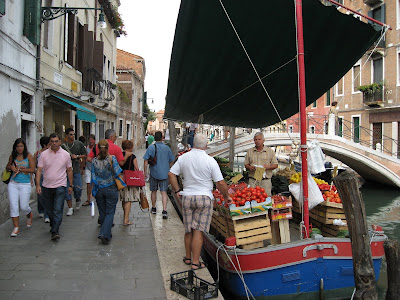
A floating vegetable store in Venice.     Photo: Hans Sandberg

Trying to find a supermarket in Rome? Good luck, and while you’re searching, stop in at one of the ancient city’s many botteghas, macellerias or salumerias to pick up something to eat and drink. Old ways live on in Italy, especially in the south, which is one reason that it took so long for the supermarket to catch on.


When the first Italian supermarket opened in Milan in 1957, it came at the prodding of Nelson Rockefeller, the American capitalist philanthropist who in 1959 became mayor of New York City and in 1976 vice president to Gerald Ford. He had sponsored similar projects in Latin America that he now introduced to Milan, a stronghold for the Italian Communist Party. The idea was that “it’s hard to be a Communist with a full belly.”

“Italy had lived through two world wars, fascism, poverty, and lacked even the most important goods,” explains Emanuela Scarpellini, associate professor at the University of Milan, and an expert on the history of the Italian Supermarket. What it didn’t lack was stores, mostly small family-run stores. In 1951, there were 951,382 stores and small businesses catering to the public in Italy. 801,837 of them had only one or two employees, 198 had more than 100, while only one had more than 500. (All according to Emanuela Scarpellini’s study “Shopping American-Style: The Arrival of the Supermarket in Postwar Italy”, published in Enterprise & Society, Vol. 5 No. 4, 2004.) And with so many small shopkeepers there was a strong political base for resistance to modernization.


Emanuela Scarpellini, professor at University of
Milan.    Photo courtesy of Emanuela Scarpellini.


The old family-owned store had its charm, and usually excellent food from local producers, but the food was costly and the supply limited. Italy’s grocery sector was “a backward sector, even compared to other European countries”, says Emanuela Scarpellini. “The same was true for the department stores. We only have two national chains in the 1950’s, La Rinascente and Standa.”


A cheese vendor in Rome.                     Photo: Hans Sandberg

Besides, the country’s infrastructure was badly damaged, making it hard to build the necessary logistic and distribution networks. “The depression, the wars and the damages delayed the creation of a national market,” she says.

The American supermarket was not the only alternative to the traditional grocer. Italy already had a very large cooperative movement, which had built buyers coops and agricultural coops. Some of the largest supermarket chains in the country emerged from the cooperative movement, and are today quite common, especially in the north. The Coop group, which consists of nine regional companies, is Italy’s largest supermarket chain, with total sales of 13 billion dollars (Riccardo Lotti, Peter Mensing, and Davide Valenti in “A Cooperative Solution”, published in Strategy + Business July 17, 2006)

But the little guy didn’t go away. “The local mom-' n'-pop stores continue to play an essential role,” wrote Dana Biasetti, an expert at the U.S. Embassy in Rome in an overview published in AgExporter in October 2002.

“Italians were accustomed to small shops, and friendly relations with the shopkeeper,” says Emanuela Scarpellini. “It was part of the social tissue of everyday life. You knew the shopkeeper and he knew you. But by the end of the 1950’s, we had this idea of modernity coming from the United States. America was coming to Italy, and the supermarket was part of that. Much of this was of course an imagined America, brought on by Hollywood movies, media icons and things like that.” America was at the time seen by many as a liberator, a beacon of political freedom, modernity and material wealth.

“With the supermarket, America not only brought in a new type of technical organization, but a symbol for the end of poverty,” says Emanuela Scarpellini.

“The supermarkets had a more efficient organization, self-service, good logistics and a different relation with the producers. They could buy big quantities, and sell at a low price. It was a revolution,” she says.

“We had new and foreign brands coming in, like Coca Cola. Self-service was also very important, because for the first time, customers could touch the goods without the mediation of the shopkeeper. This changed your relation to the goods,” she says.

When growth took off in post-war Italy, people’s income went up giving them money to spend. And the supermarkets and department stores could reach them in new ways through television and TV-advertising. Small stores couldn’t afford that, and were not able to respond to the demand for new categories such as frozen food. “They simply did not have freezers and refrigerators,” she says.


A small supermarket in Montesarchio in southern Italy.
                                                           Photo: Hans Sandberg


Once the supermarkets had established their viability, they were sold to Italian investors, who built new stores and chains. Still, it took a long time for them to become popular. In the 1970’s, supermarkets had less than five percent of food retail sales, according to Emanuela Scarpellini.

“You would find supermarkets mostly in the big cities in the north, in Milan and Turin, and then in Rome and Venice. We must also take into account the fierce opposition by the small shopkeepers and their politicians, who fought this development.”

“Italy was a very decentralized culture, where the butcher and the baker was part of the local infrastructure. And local licensing laws tried to preserve this structure.”

“Political parties such as the Christian Democrats were very weary and worried about the new supermarkets, and feared that their voters would be hurt. They saw it as a question of defending the social fabric, and not only about economics. It was a social and political issue. So we heard a lot about monopolistic capitalism in the 1960’s and 1970’s.”

The relatively underdeveloped domestic Italian retail sector made it easier for French and German food retail giants such as Carrefours and Lidl to set up large new shopping centers and hypermarkets. “After the 1970’s, with the liberalization and globalization, we saw more of the international companies in Italy,” she says, adding “they became important players in 1980’s and 1990’s, especially in the north.”


A new Carrefour "hypermarket" north of Neaples.
                                                                Photo: Hans Sandberg


The international chains increased the pressure on Italy’s food manufacturers as they drove up the imports, as well as forced change and more emphasis on logistics, efficient production and production for export.

“The industry saw that this was the future, that they had to change, and compete on quality, and even price. This was an important adaptation for the Italian food industry.”

One could think that small shops would benefit from the new logistics systems or using the Internet, but the big chains have their own organizations, according to Emanuela Scarpellini. There are local or regional chains for small independent stores, but their way of competing is to “find a particular producer that can give them a special product. They try to differentiate, so that they can offer something unique,” says Emanuela Scarpellini.

“We now have the slow food movement, and many Italian producers have focused on high quality food. The food industry is becoming more important, like the fashion industry. They also contribute to selling the image of Italy.“

The modern supermarket was a response to social change, and caused its own changes.

“It brought men into the supermarket,“ says Emanuela Scarpellini. “Shopping was previously only made by women, but now men entered and took part in this activity.”

One reason for this was that women usually did not drive, and the car was essential as many supermarkets were located outside the city. The supermarkets also had an impact on women’s role in society, both as it provided new jobs for women and helped workingwomen, who could not spend as much time as before on daily shopping.

Today both the supermarket and the mom & pop store co-exist in Italy.

“Today, the supermarkets have more than 50 or 60 percent of sales. They are dominating the market, but the numbers are still lower than for other European countries. There is still an important place for small shops in Italy.”

Half a century has passed since has passed since Italy got its first supermarket. At that time, it filled a need that was deep and sometimes desperate, but still faced resistance on many levels. It won the hearts and minds of the Italians by providing a wide variety of goods at relatively low prices. Back in the 1950’s, one customer was so happy about it that she told Roland Hood, one of the supermarket pioneers, “I have written to my sister in New York and told her to vote for Mr. Rockefeller if he ever runs for Governor again.” Another said “I’m sure God has sent you Americans to do this wonderful thing for us in Italy.” Yet another was overheard saying, “just remember this next time you vote, they don’t have any of these in Russia.” (Emanuela Scarpellini, 2004, p 662)

Whether it saved the country from another revolution is, as most things are in Italy, open for debate.

Hans Sandberg

Monday, September 8, 2008

Republican Dishonesty And A Couple of Cool Clips

The Democratic Convention was great and brimming with hope, while the Republican Convention - once Gustav's (or God's for those of you who are believers...) rage subsided enough to let it start - was a display of deep dishonesty.

There was a moment when I felt that John McCain was playing the foreign policy card so that he could get some elbow room versus the religious right, but now we know that that wasn't the case. McCain does what he does for his own sake. He uses people to get where he wants to get. He doesn't hesitate to lie and cheat, but still claims that we have to believe him because he got shot down over Vietnam. But character is not something that is cut in stone, and especially not an opportunistic character such as McCain's. Republicans often try to make people believe that character is what sets them apart compared to the wishy-washy flip-flopping liberals. But it is a charade intending to hide the fact that the Republican message of "small government" and "tax cuts" would hurt most people. If they focused on the message they wouldn't have a chance, so they focus on the "war hero" instead, and the nobody from nowhere with perfect fundamentalist credentials. 

For an uplifting take on Republican hypocrisy, watch this wonderful piece on the Daily Show!

Thursday, September 4, 2008

Swedish-American Business Book


I just published a book about the Swedish-American business world on the Print-On-Demand website Lulu.com.  

Click here to see the book on Lulu.com!

Hans Sandberg