I picked up Lisa at Newark Airport, and then we headed over to Ikea for a romantic dinner with a gorgeous view of the Turnpike (well, it was dark so all we could see through the panorama windows was the lights of cars, streetlights and incoming airplanes). We had stopped at Ikea in Elizabeth to pick up some Swedish food in the mini market, but we came away pretty disappointed. Ikea is doing the "New Coke" thing, phasing-out the good old Swedish brands and replacing them with Ikea-branded food. Flat-packed chocolate doesn't look as appetizing as the Marabou's we used to buy, and they had signs warning us that we better buy the Siljans knäckebröd now, because soon you will have to make do with Ikea branded bread. For ex-patriots like myself, a visit to Ikea is a visit to the old country, and it is nice to be able to buy Kalles kaviar, Västerbottensost and Lingonsaft, but that will soon be history.
Not only that. Ikea is now selling half-size packages of soft tunnbröd for the same price as the full sized bread I used to buy, and the substitute for the "Hönökaka" is not only square, but nouveau in size, or approximately one third of what it used to be.
I left Ikea sad and disappointed. Is it good business? Well, everytime I visit Ikea to pick up Swedish food, I usually spend a couple of hundred dollars in the store. Without the food, I won't bother to drive to Ikea anytime soon.
Friday, November 4, 2011
Worst Thing Since the New Coke - Flat-Packed Swedish Food at IKEA
Posted by
Hans Sandberg
at
10:16 PM
2
comments
Labels: food retail, Ikea, retail, Sweden, Swedish-American
Sunday, July 24, 2011
A Huge Problem with an Obvious Solution
Bad Food? Tax It, and Subsidize Vegetables
A great expose by Mark Bittman. It is a life and death issue, and addressing it could lower the deficit.
Subsidized. Photo: Hans Sandberg "WHAT will it take to get Americans to change our eating habits? The need is indisputable, since heart disease, diabetes and cancer are all in large part caused by the Standard American Diet. (Yes, it’s SAD.)....changing it /our diet/ could improve our health and save tens of millions of lives..... and... save tens if not hundreds of billions of dollars in health care costs.Yet the food industry appears incapable of marketing healthier foods.... Their mission is not public health but profit, so they’ll continue to sell the health-damaging food that’s most profitable, until the market or another force skews things otherwise. That “other force” should be the federal government, fulfilling its role as an agent of the public good and establishing a bold national fix.
Not subsidized.
Rather than subsidizing the production of unhealthful foods, we should turn the tables and tax things like soda, French fries, doughnuts and hyperprocessed snacks. The resulting income should be earmarked for a program that encourages a sound diet for Americans by making healthy food more affordable and widely available."
It's so obvious and makes so much sense and would save so much money that one wonders if it ever could be done. It's almost like if we were to get people to stop smoking.... oh, we actually did that, and it worked. And we do regulate and tax tobacco. Why isn't the Tea Party huffing and puffing about that?
Hans Sandberg
Tuesday, March 29, 2011
Hidden Inflation is Here Again
I've notis for the past couple of years how packages are shrinking, while prices stay the same. It's cheating, it's hidden price increases.
And it's about time that somebody reports about it, which New York Times did today.
Food Inflation Kept Hidden in Tinier Bags
Posted by
Hans Sandberg
at
11:31 PM
0
comments
Labels: economy, food retail, USA
Thursday, September 10, 2009
Norway to fill the void left by Chile’s collapsing salmon export
Norway’s salmon farmers stand ready to grab a huge chunk of the U.S. fish market left by Chile’s shrinking salmon export to the U.S., which will drop 40 percent in 2009, and another 70 percent in 2010. “Norwegian salmon could jump from five percent of the U.S. market to 25 percent,” says Børge Grønbeck, marketing manager at the Norwegian Seafood Export Council during a visit to New York.
Børge Grønbeck was in New York as part of the export council’s plans to reopen its U.S. office and start a campaign to boost Norway’s export of farmed Atlantic salmon to the U.S. “Chile holds 50-60 percent of the U.S. market, but there has been a serious decline since 2008 due to the ISA-virus (infectious salmon anemia),” he says, adding that Norway, which is the largest producer of farmed salmon in the world, wants to fill the gap left by Chile’s falling export. “We have the capacity and Norwegian salmon is well known,” he says.
Norway produces about 750,000 tons live weight of farmed salmon yearly out of a world production of about 1.5 million tons. The U.S. market for seafood is the third largest in the world, and 88 percent of the U.S. seafood consumption was imported in 2008.
Børge Grønbeck says that Chile’s regulation of its fish farms have been lax, allowing them to sit too close to each other, making the vulnerable to disease. Norway on the other hand, has had a strict regulatory framework, emphasizing sustainability, and spreading out its salmon farms to limit the use of antibiotics. A recent report in the New York Times said that in 2008 Chile used 350 times more antibiotics in its farmed salmon than Norway did in its farms. (718,000 pounds vs. 2,075 pounds)
For Norway, this is not just a one-time shot, but also potentially a long-term gain on its number one international competitor in the farmed salmon business. “It will take many years before Chile is back,“ Børge Grønbeck says.
Filling the void left by Chile is only one part of the new Norwegian strategy. “American eat too little seafood,” he says, adding that this presents both an educational and a PR-challenge. American’s eat relatively little seafood and salmon, which makes the growth potential the bigger. Americans eat on average 7.4 kg seafood per person and year, which is much less that in Europe and Norway (where the seafood consumption is three times the U.S. average.) Farmed salmon captures 15 percent of the seafood consumption in the U.S., which amounts to 280,000 ton. (It takes about 15 kg live weight salmon to produce 7.4 kg filleted salmon.)
The council hopes to teach both the distributors and retailers how to inform the consumer better and be more efficient in selling salmon. It is also important to educate the consumer about the health benefits of eating salmon, and overcome consumer fear of eating fish. “Many consumers simply don’t know how to prepare salmon, and think it is hard to cook it,” he says. “Once you show them, they often burst out that ‘I didn’t know it was that easy!’” When the council had a campaign in Norway to address this issue, it led to a big increase in sales during the grill season.
The Norwegian strategy will also push for easy to prepare meal solutions, better displays in supermarkets, and better branding of Norwegian salmon. In many supermarkets it can be hard to find out where the salmon comes from, and there is little advice for how to select and prepare your salmon.
It seems as Norway have a leg up on its competitors when it comes to farmed salmon, but there are environmentalist that criticize the entire industry of farmed seafood. “The growing global appetite for cheap farmed salmon is imperiling wild fish populations across the planet,” according to scientists quoted by the National Geographic magazine (February 12, 2008.) "Salmon farming seems to have a negative impact on wild salmon," Jennifer Ford, a lead researcher of Dalhousie University, in Halifax, Nova Scotia, told the magazine. Her research was however put in doubt by Marine Harvest, the world’s largest salmon farming company. Other factors have contributed to the decline in wild salmon, according to the company.
Hans Sandberg
Posted by
Hans Sandberg
at
7:46 AM
0
comments
Labels: export, food retail, Norway, salmon
Friday, January 9, 2009
Food For Thought - The Meatrix
I just discovered The Meatrix, which came out a year ago or so. It's a spoof of The Matrix movie, but fun and for a very good cause.
Go to The Meatrix site and watch the movies.
http://www.themeatrix.com/
Hans
Posted by
Hans Sandberg
at
10:57 AM
0
comments
Labels: environment, food retail
Friday, September 12, 2008
How the Supermarket Won Italy’s Hearts and Minds
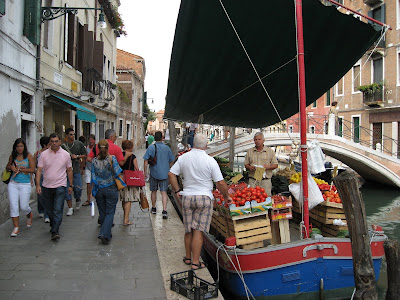
A floating vegetable store in Venice. Photo: Hans Sandberg
Trying to find a supermarket in Rome? Good luck, and while you’re searching, stop in at one of the ancient city’s many botteghas, macellerias or salumerias to pick up something to eat and drink. Old ways live on in Italy, especially in the south, which is one reason that it took so long for the supermarket to catch on.
When the first Italian supermarket opened in Milan in 1957, it came at the prodding of Nelson Rockefeller, the American capitalist philanthropist who in 1959 became mayor of New York City and in 1976 vice president to Gerald Ford. He had sponsored similar projects in Latin America that he now introduced to Milan, a stronghold for the Italian Communist Party. The idea was that “it’s hard to be a Communist with a full belly.”
“Italy had lived through two world wars, fascism, poverty, and lacked even the most important goods,” explains Emanuela Scarpellini, associate professor at the University of Milan, and an expert on the history of the Italian Supermarket. What it didn’t lack was stores, mostly small family-run stores. In 1951, there were 951,382 stores and small businesses catering to the public in Italy. 801,837 of them had only one or two employees, 198 had more than 100, while only one had more than 500. (All according to Emanuela Scarpellini’s study “Shopping American-Style: The Arrival of the Supermarket in Postwar Italy”, published in Enterprise & Society, Vol. 5 No. 4, 2004.) And with so many small shopkeepers there was a strong political base for resistance to modernization.

Emanuela Scarpellini, professor at University of
Milan. Photo courtesy of Emanuela Scarpellini.
The old family-owned store had its charm, and usually excellent food from local producers, but the food was costly and the supply limited. Italy’s grocery sector was “a backward sector, even compared to other European countries”, says Emanuela Scarpellini. “The same was true for the department stores. We only have two national chains in the 1950’s, La Rinascente and Standa.”

A cheese vendor in Rome. Photo: Hans Sandberg
Besides, the country’s infrastructure was badly damaged, making it hard to build the necessary logistic and distribution networks. “The depression, the wars and the damages delayed the creation of a national market,” she says.
The American supermarket was not the only alternative to the traditional grocer. Italy already had a very large cooperative movement, which had built buyers coops and agricultural coops. Some of the largest supermarket chains in the country emerged from the cooperative movement, and are today quite common, especially in the north. The Coop group, which consists of nine regional companies, is Italy’s largest supermarket chain, with total sales of 13 billion dollars (Riccardo Lotti, Peter Mensing, and Davide Valenti in “A Cooperative Solution”, published in Strategy + Business July 17, 2006)
But the little guy didn’t go away. “The local mom-' n'-pop stores continue to play an essential role,” wrote Dana Biasetti, an expert at the U.S. Embassy in Rome in an overview published in AgExporter in October 2002.
“Italians were accustomed to small shops, and friendly relations with the shopkeeper,” says Emanuela Scarpellini. “It was part of the social tissue of everyday life. You knew the shopkeeper and he knew you. But by the end of the 1950’s, we had this idea of modernity coming from the United States. America was coming to Italy, and the supermarket was part of that. Much of this was of course an imagined America, brought on by Hollywood movies, media icons and things like that.” America was at the time seen by many as a liberator, a beacon of political freedom, modernity and material wealth.
“With the supermarket, America not only brought in a new type of technical organization, but a symbol for the end of poverty,” says Emanuela Scarpellini.
“The supermarkets had a more efficient organization, self-service, good logistics and a different relation with the producers. They could buy big quantities, and sell at a low price. It was a revolution,” she says.
“We had new and foreign brands coming in, like Coca Cola. Self-service was also very important, because for the first time, customers could touch the goods without the mediation of the shopkeeper. This changed your relation to the goods,” she says.
When growth took off in post-war Italy, people’s income went up giving them money to spend. And the supermarkets and department stores could reach them in new ways through television and TV-advertising. Small stores couldn’t afford that, and were not able to respond to the demand for new categories such as frozen food. “They simply did not have freezers and refrigerators,” she says.
A small supermarket in Montesarchio in southern Italy.
Photo: Hans Sandberg
Once the supermarkets had established their viability, they were sold to Italian investors, who built new stores and chains. Still, it took a long time for them to become popular. In the 1970’s, supermarkets had less than five percent of food retail sales, according to Emanuela Scarpellini.
“You would find supermarkets mostly in the big cities in the north, in Milan and Turin, and then in Rome and Venice. We must also take into account the fierce opposition by the small shopkeepers and their politicians, who fought this development.”
“Italy was a very decentralized culture, where the butcher and the baker was part of the local infrastructure. And local licensing laws tried to preserve this structure.”
“Political parties such as the Christian Democrats were very weary and worried about the new supermarkets, and feared that their voters would be hurt. They saw it as a question of defending the social fabric, and not only about economics. It was a social and political issue. So we heard a lot about monopolistic capitalism in the 1960’s and 1970’s.”
The relatively underdeveloped domestic Italian retail sector made it easier for French and German food retail giants such as Carrefours and Lidl to set up large new shopping centers and hypermarkets. “After the 1970’s, with the liberalization and globalization, we saw more of the international companies in Italy,” she says, adding “they became important players in 1980’s and 1990’s, especially in the north.”

A new Carrefour "hypermarket" north of Neaples.
Photo: Hans Sandberg
The international chains increased the pressure on Italy’s food manufacturers as they drove up the imports, as well as forced change and more emphasis on logistics, efficient production and production for export.
“The industry saw that this was the future, that they had to change, and compete on quality, and even price. This was an important adaptation for the Italian food industry.”
One could think that small shops would benefit from the new logistics systems or using the Internet, but the big chains have their own organizations, according to Emanuela Scarpellini. There are local or regional chains for small independent stores, but their way of competing is to “find a particular producer that can give them a special product. They try to differentiate, so that they can offer something unique,” says Emanuela Scarpellini.
“We now have the slow food movement, and many Italian producers have focused on high quality food. The food industry is becoming more important, like the fashion industry. They also contribute to selling the image of Italy.“
The modern supermarket was a response to social change, and caused its own changes.
“It brought men into the supermarket,“ says Emanuela Scarpellini. “Shopping was previously only made by women, but now men entered and took part in this activity.”
One reason for this was that women usually did not drive, and the car was essential as many supermarkets were located outside the city. The supermarkets also had an impact on women’s role in society, both as it provided new jobs for women and helped workingwomen, who could not spend as much time as before on daily shopping.
Today both the supermarket and the mom & pop store co-exist in Italy.
“Today, the supermarkets have more than 50 or 60 percent of sales. They are dominating the market, but the numbers are still lower than for other European countries. There is still an important place for small shops in Italy.”
Half a century has passed since has passed since Italy got its first supermarket. At that time, it filled a need that was deep and sometimes desperate, but still faced resistance on many levels. It won the hearts and minds of the Italians by providing a wide variety of goods at relatively low prices. Back in the 1950’s, one customer was so happy about it that she told Roland Hood, one of the supermarket pioneers, “I have written to my sister in New York and told her to vote for Mr. Rockefeller if he ever runs for Governor again.” Another said “I’m sure God has sent you Americans to do this wonderful thing for us in Italy.” Yet another was overheard saying, “just remember this next time you vote, they don’t have any of these in Russia.” (Emanuela Scarpellini, 2004, p 662)
Whether it saved the country from another revolution is, as most things are in Italy, open for debate.
Hans Sandberg
Posted by
Hans Sandberg
at
4:05 PM
0
comments
Labels: food retail, Italy, supermarkets
Tuesday, September 13, 2005
Americans Are Finally “Getting” Cheese
If you ask for American Cheese in an American supermarket, chances are that you will be offered a small square block of an industrially processed product that is pre-sliced and individually wrapped, but has little if any taste. But the American cheese landscape is changing, and could follow the path towards sophistication, similar to what happened to the country's coffee and wine culture over the past few decades.
Artisanal opened in 2001 and seats about 180 people. One of the most popular items on the menu is the cheese fondue, of course! Many customers, who come in for lunch or dinner, and smell the cheese, end up buying a piece of hand made and often pungent cheese from the cheese deli, which sits along one side of the restaurant.
It is a bit of a paradox that cheese is gaining in popularity at the same time as health care experts and mass media warn of the obesity epidemic, but Frank Bismuth gives at least some of the credit for the current cheese craze to the Atkins diet, which allows its dieters to indulge in fatty foods, as long as they cut back on the carbohydrates. “You can enjoy your cheese without feeling guilty,” he adds.
Hans Sandberg
Posted by
Hans Sandberg
at
10:15 AM
0
comments
Labels: artisanal cheese, food retail, New York, restaurants


